Friday, February 15, 2013

Thursday, February 14, 2013

St.Valentine's Day in Finland

While the world today celebrates love, in Finland February 14 is celebrated largely as the Friends' Day - 'Ystävänpäivä'. 
I wrote shortly about this issue last year, so today I will focus on the romantic side of St.Valentine's Day by sharing photos I took few days ago in Helsinki. 
I had no idea, that in Helsinki harbour on the way to Katajanokka there is a bridge with the love padlocks.
I found in internet information from year 2010 that the City of Helsinki has no intention of removing the padlocks, 
so I see that this custom is not so new here. 
I find these padlocks charming and wish especially today good luck for their owners:-)

  Happy Valentine's Day to All! 


Wednesday, February 13, 2013

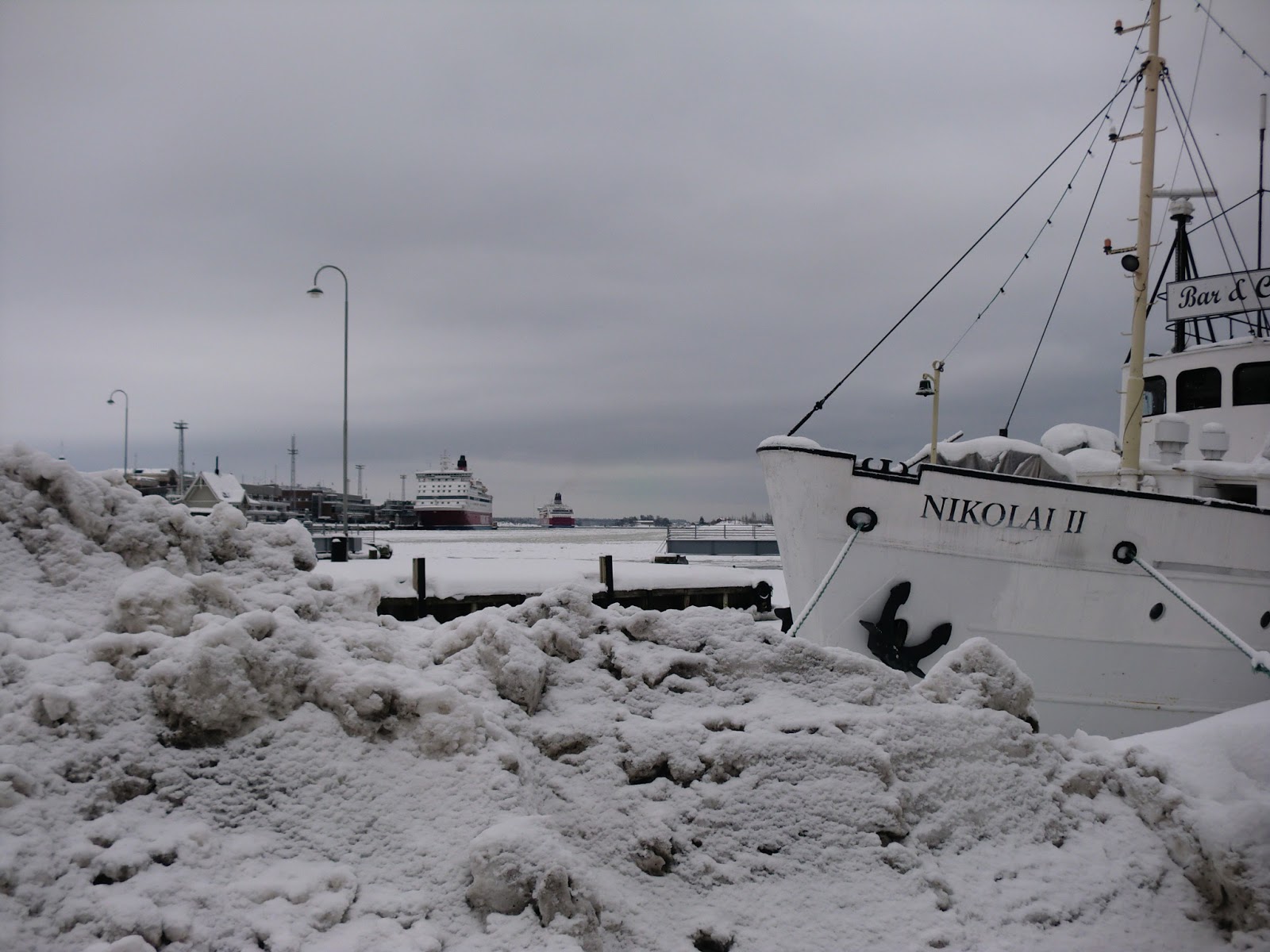
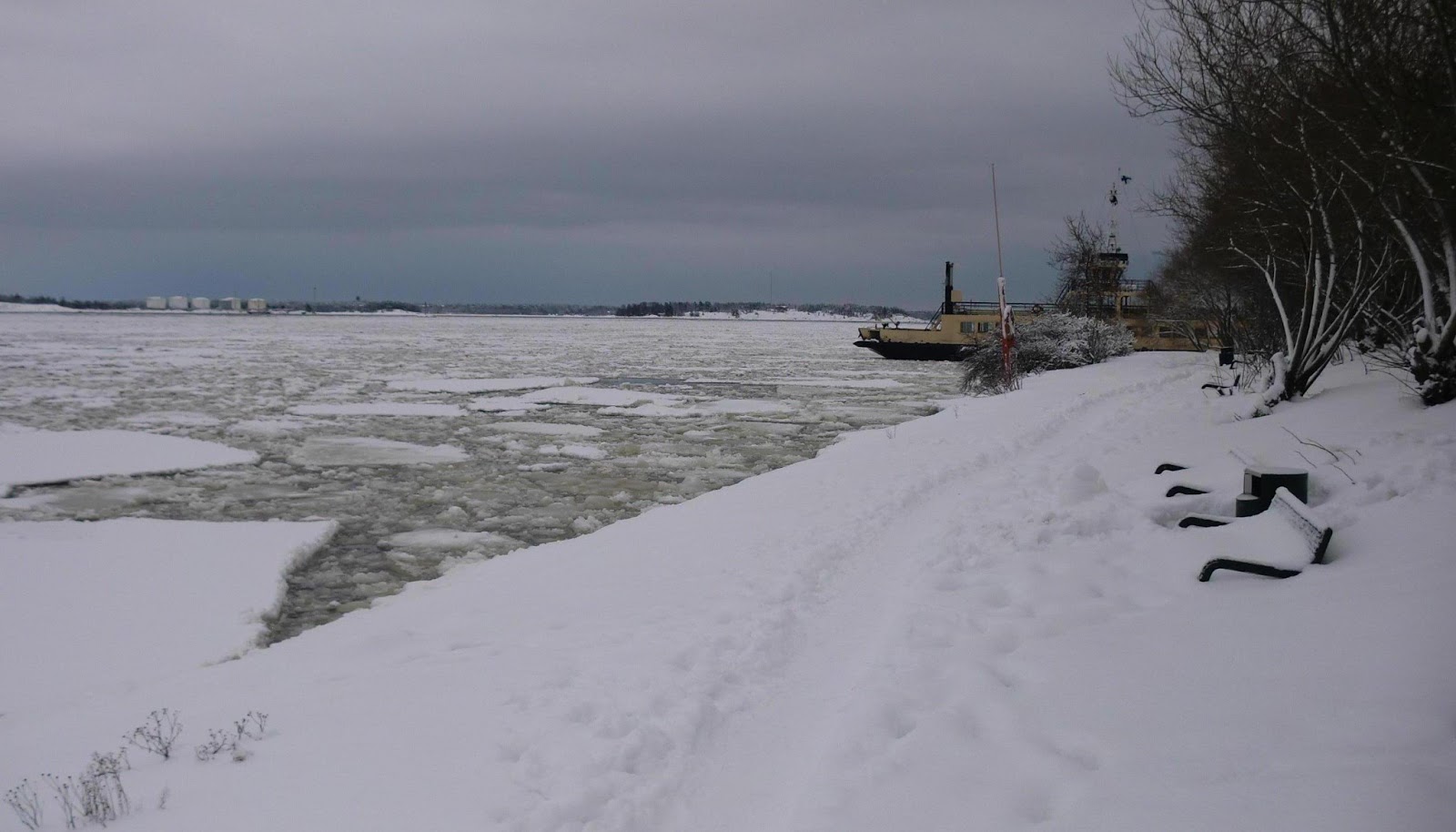
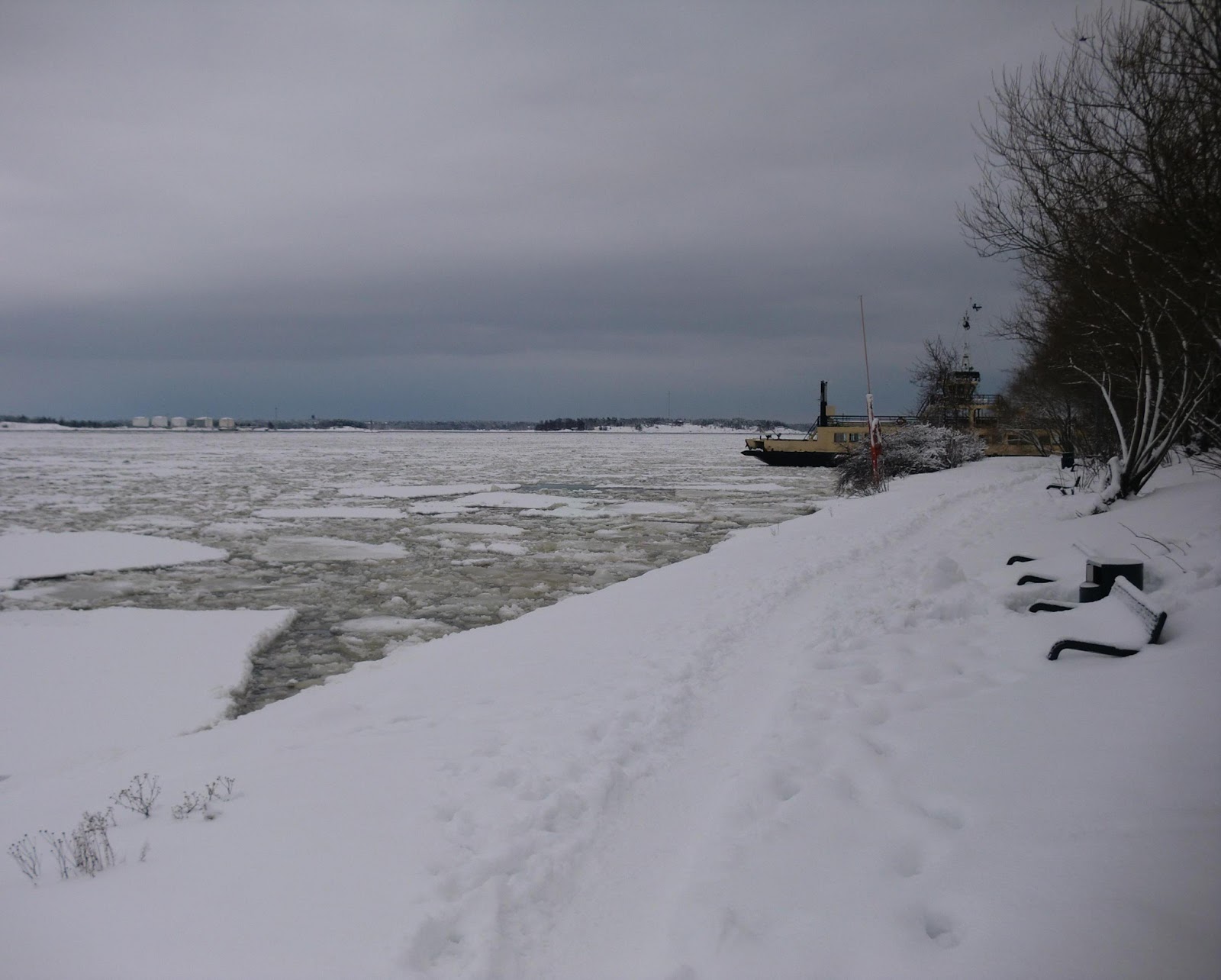
grey, winter Helsinki shore ...

Here are some pictures
I took today in Helsinki. There was calm, unhurried atmosphere
I like, and by atmosphere I mean the feeling, not the weather!:-)
Today there were only SISU and Nordica of the icebreakers in the northern shore of Katajanokka. 
I guess the rest of them are on the icebreaking assignments.

view to kruununhaka


Thursday, February 7, 2013

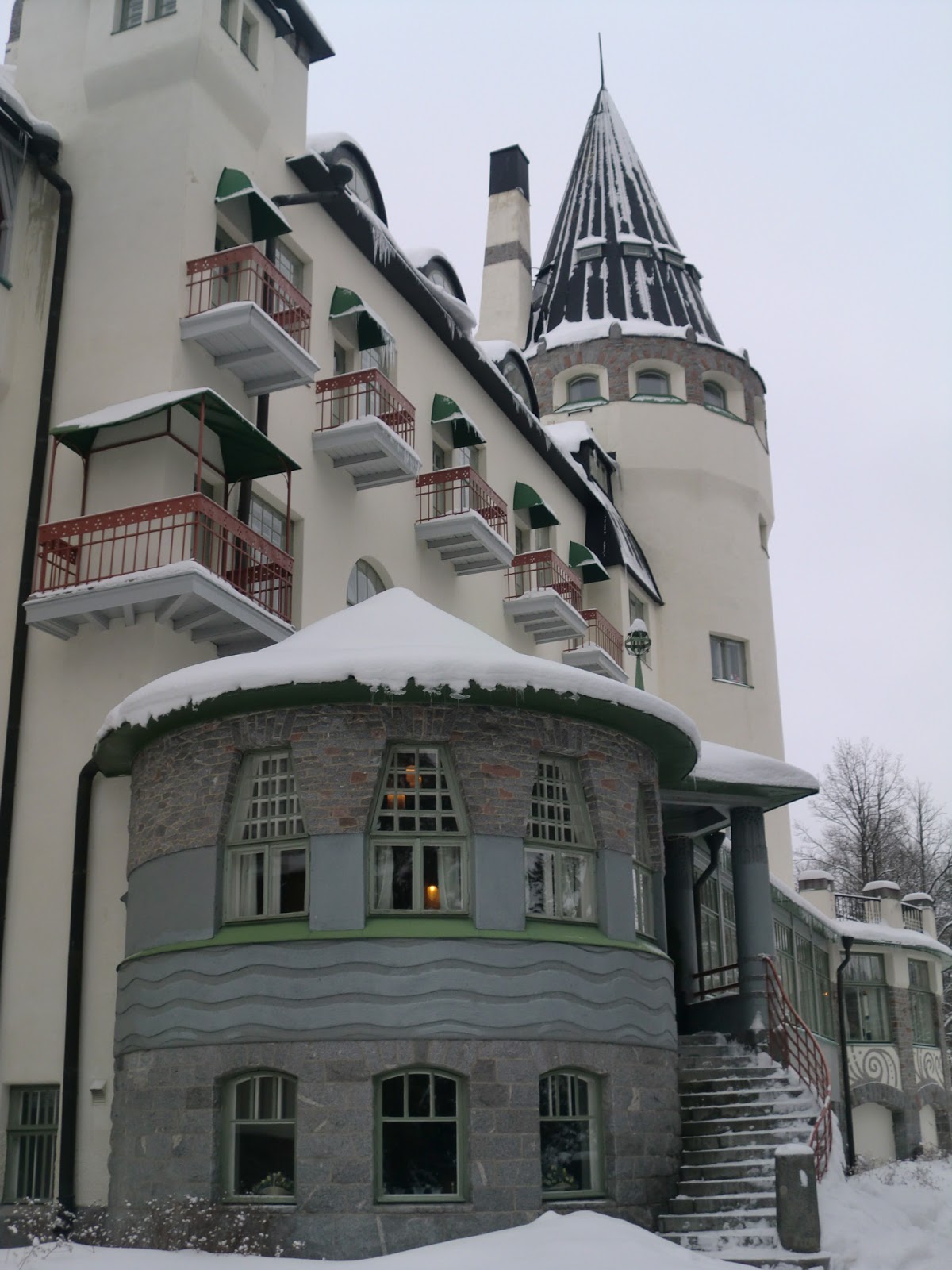
The Imatrankoski Rapids, the dam of Imatra and Imatran Valtionhotelli in the winter


The Imatrankoski Rapids on the river Vuoksi in Imatra are the oldest Finnish tourist attraction. They have been popular place to see already in the 17th century. Empress of Russia - Catherine the Great came to admire them in 1772.

In 1920's on the rapids was built the dam as a part of the hydroelectric power plant. After opening the plant in 1928, the river does not flow freely. During summer there are daily shows accompanied by music, when the dam is opened letting the water flow for about 30 minutes.


Imatran Valtionhotelli (the State Hotel) was built by the Finnish senate in 1903.
It is located very near to the dam and rapids. The hotel designed by Usko Nystroem is in an Art Nouveau (Jugend) style. It was built as a hotel for tourists from the Russian Imperial capital Saint Petersburg. As you can see it looks fabulous even in a grey winter day.


Tuesday, February 5, 2013

February 5th - the Runeberg's Day

Today Finland celebrates Runeberg's Day. Johan Ludvig Runeberg  
is regarded as the national poet of Finland. Each year on the 5th of February Finnish cafés and groceries serve the Runeberg's Tarts (Runebergintortut) - round cakes flavored with almonds and rum or arrack, with raspberry jam and sugar ring icing on top. 
The tarts are named aften his name and eaten in his honour.
Some facts about Runeberg:
- he was born in a Swedish-speaking family on 5th of February 1804,
- he wrote in Swedish as it was his mother tongue,
- his works were about the people and nature of Finland, Finnish peasants' life, persistency and determination (sisu). He also wrote patriotic poems on the Finnish War of 1808-09 with Russia,
- his poem "Vårt land" (Our Land, in Finnish "Maamme") became lyrics of the Finnish National Anthem,
- Jean Sibelius wrote music to number of his poems, 
- Runeberg had also big influence on Swedish literature. He received Swedish Academy's highest award for poetry,
- in 1837 he became professor of Latin and Greek literature in the Borgå College (Gymnasium of Porvoo). In 1847 he was appointed rector of the college. Lived in Porvoo until death.
- in 1852 he moved with family to home, which is nowadays opened for public as the museum, (here's link in english),
- he was married to Fredrika Charlotta Runeberg, daughter of the archbishop of Finland, 
- his wife was also a noted writer. She wrote historical novels and was the first Finnish newspaper-woman,  - they had eight children,
- at age of 61 during a huntinting trip Runeberg suffered a stroke, after which he became severely incapacitated. His wife was taking imposing, everyday good care of him untill his death in 1877,
- the statue of Runeberg in Esplanadi Park in Helsinki was created by his son Walter Runeberg - 
a great Finnish sculptor (his another famous work is the monument of Alexander II in Helsinki Senate Square),
- Runeberg's Day is a flag day in Finland

Runebergs Tarts, producers: Haagan leipä, Linkosuo, Rosten, Marian konditoria, Kakku & Leipä Keisari ja Fazer. Photo: http://ruoka.fi

Wednesday, January 30, 2013

different shades of the Finnish snow ...

There is popular belief that Eskimos have about hundred words for snow. I did small internet research on this subject and found out, that this number is vastly exaggerated.
The Eskimo languages are divided into two main groups (Yupik and Inuit) and numerous dialects.
They include many words of the same origin but in slightly modified versions within dialects, what gives impression of larger number of words than there really are.
According to Wikipedia Saami people (living in far northern parts of Finland, Norway, Sweden and Russia) use about 180 words for snow and ice. Ole Henrik Magga, Professor of Saami languistics from Saami University College in Guovdageaidnu, Norway, wrote interesting article: 'Diversity in Saami terminology for reindeer and snow' (here's link). He described there in English ca.90 Saami words for snow and ice. (and ca.140 relating to reindeers).
As to the Finnish words for snow and ice, someone has already done a big work to translate many of them into English what I have copied below to present complexity of this vocabulary. (here's the link to source I got it from):  
'lumi: snow, pyry: snow shower, myräkkä: snowstorm, rae: hail, räntä: sleet, tuisku: snow shower with strong win, laviini: a small avalanche, hyhmä: snow floating atop water, loska: very wet snow; snow, water and mud mixed togethe, sohjo: slush, snow and water mixed together, ahto: pack-ica (broken & refrozen ice, ahtauma: a formation of pack-ice, jää: ice, kide: ice crystal, kohva: gray ice formed from wet snow, paanne: multi-layered ice (typically waves crash on top and freeze), railo: pressure ridge in ice, röpelö: uneven ice, tökkö: ice with frost on top, iljanne: a thin layer of snow atop ice, hanki: a even layer of snow on the ground, esp. if enough for skiin, huurre: rime; granular frost (the white stuff in your freezer), härmä: frost, kinos: snow drift; a loose pile of snow, esp. one formed by wind, kaljama: a thick layer of ice on the ground, lethal in the sprin, kuura: hoarfrost; frozen dew, nietos: a large, hard pile of snow (may be refrozen), nuoska: "snowballable" snow, usually formed when powdery snow melts a bit, polanne: a hard layer of compacted snow, tykky: large chunks of snow, esp. when frozen onto trees, viti: freshly fallen powdery snow, avanto: a hole in ice, jotos: reindeer tracks in snow, latu: a ski trail in snow, rannio: a reindeer path in deep snow.'
Additionally there are numerous words for snow and ice in Finnish dialects.
The most popular words relating to snow not listed above:
lumiukko - snowman
lumihiutale - snowflake
lumisade - snowfall
lumimyrsky -  snowstorm, blizzard
Finnish military uniforms have always included the snow version (lumipuku), nowadays Finnish Defence Forces use snow trousers and jackets. There are also snow outfits for hunters.
Some of my snowy Finnish photos are here and here

Below photo taken from our window. I wonder what would be proper word for that ...

Tuesday, January 22, 2013

purple sunset

There was very beautiful sunset yesterday. Here's picture taken from our window. Finally some concrete sunset! There was nothing noticable to set down actually for few last weeks, as most of days were grey. The sun has been stubbornly hiden or indiscernible, and today it appeared with the real light.
Exactly during midday I was riding bicycle. About 12 o'clock the sun reaches its highest point in the sky during the natural day, so I was surprised to see my shadow on the snowy road ca. 5m long!
Watching the dark sky at 8 am does not give much energy to start a new day. It is good to realize that anyhow every day becomes longer, so I appreciate this purple sunset and wait for more:-)

Wednesday, January 16, 2013

the road tunnels in Finland

At the beginning of this month we made a trip to Turku. 
I have been to Turku only once 10years ago, so I was surprised at the road tunnels we drived through on the Finnish national road 1 (Valtatie 1), (Motorway E18) from Helsinki. There are 7 double-bore road tunnels between Muurla and Lohja (Hepomäki, Lakiamäki, Tervakorpi, Pitkämäki, Orosmäki, Karnainen ja Lehmihaka).
Their combined lenght is 5,2km. The longest one - Karnainen Road Tunnel (Karnaisten tunneli) is 2,3km.
It's the longest road tunnel in Finland. 
Tunnels' construction was completed in 2009.
Tunnels are equipped with the emergency exits and SOS-phones.
The road leading often between high rock walls
is nice and impressive.


The below picture comes from http://www.ykkostie.net/tunnelit.html

Here's LINK about other road tunnels in Finland, and below my photos of the tunnels:

It looks like Finns like the tunnels. Turun Sanomat newspaper from Turku published on 2.12.2012 project of Marco Casagrande (the picture below). The architect has vision of drilling tunnel under centre of Turku. He says "Lowering the road into a tunnel going under the Aura River would free the heart of Turku from cars for good. And Turku is worth it." (here's link to his blog, this post is in English). Reading comments on the internet I see that this project has many enthusiasts. 
Times shows if this dream comes true ...


Thursday, January 10, 2013

Short winter trip to Naantali and Turku

After spending Christmas at home we left to Naantali and Turku for few days for a change. 
The weather seems to stay gloomy forever. The amount of coffee I drink increases every day 
and the winter will last here at least until April. 
I find small consolation in fact, that days are becoming longer since Christmas.  
Naantali is under 20000 of population city 15km from Turku. Small beautiful city most known for the Moomin World and Naantali Spa Hotel. The Moomin World is closed during winter. 


We visited Turku Cathedral, Finland's national shrine. It was built already in the late XIII century, initially as a wooden church, 100years later rebuilt with stone. The cathedral is tremendous and really impressive.


Tuesday, January 1, 2013

Have a very Happy New Year 2013! Onnellista Uutta Vuotta! Szczęśliwego Nowego Roku!

Wishing everyone a very happy and prosperious New Year! 
Hopefully 2013 brings just good luck and will be better than 2012.
'Foreigner in Finland' toivottaa kaikille erittäin hyvää Uutta Vuotta!
Toivottavasti vuosi 2013 tuo onnea, menestystä ja on
kulunutta vuotta paljon parempi.

Wednesday, December 26, 2012

Christmas cards overview

It came to my mind to make a short overview of the Christmas cards I got this year.
Looking at the cards sent from Finland and from Poland I can see a clear difference.
Some of the Polish cards present Santa Claus or the Christmas tree, some are amusing but most of them  refer to the birth of Christ, present Nativity scenes or the Three Wise Men.

The Finnish cards in general present a different approach. I have seen mostly cheerful elfs, Santa Claus, reindeers, the forest animals and snowmen.

I see every year cards with photos of the animals with the christmas hats on (tonttulakki).
I must admit that I have mixed feelings about them, maybe because I got used to the religious Polish cards. Anyhow my son asked me to buy the cat and the dog card to 'decorate' our kitchen, so we have these ones home also:-).

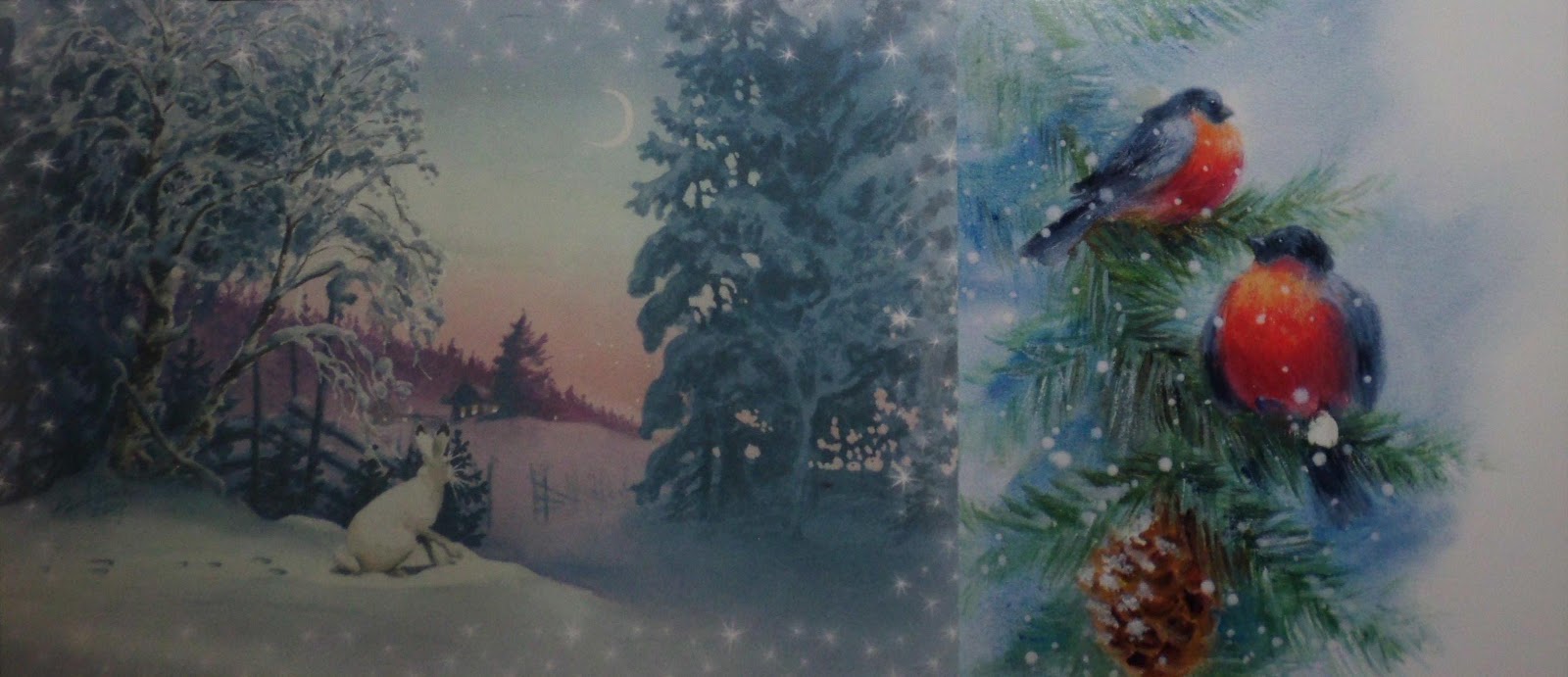
There are of course also Finnish earnest cards wishing the Peaceful or the Blessed Christmas (including picture of church, Jesus, angels or candle), and the winter nature scenes cards, often with photos or ilustrations of the bullfinches (punatulkku) or forest.

I would like to present also a very original Christmas card I got this year, reproduction of work of the Finnish artist Reetta Isotupa-Siltanen:-)

Ach! and of course the handmade ones which my sons created this year:

Tuesday, December 25, 2012

Merry Christmas Everyone!

"Christmas is a time when you get homesick - even when you're home". Carol Nelson

I find this quote adequate to this blog but not because I am Pole spending Christmas in Finland.
I noticed, that Christmas brings to my mind thoughts about Christmas of my childhood, so no mater where I spend Christmas nowadays I would miss Christmases from the old times.
It was a magical time and the whole world seemed to be envolved into a celebration.
On the Polish Christmas Eve supper all the family members gather togehter to fulfill tradition of breaking off and exchanging parts of the opłatek (wafer baked from pure wheat flour and water).
It is symbol of  exchanging blessings and good wishes.
Christmas Eve in Poland is a day of fasting. At the appearance of the first star starts the Christmas Eve supper but there is any meat on the table. The main dish is fried carp and beetroot soup - while in Finland a main dish on a Christmas Eve supper is joulukinkku (Christmas ham:-) 
There is also Midnight Mass celebrating the birth of Jesus Christ.
My father used to buy a real Christmas tree to our home, and I remember each of over hundred of baubles and other decorations.
We used to visit different churches to admire the Nativity scenes and the Christmas trees and lights. The Christmas carols in Poland are numerous, beautiful and very popular not only in churches.
Im sure that every Pole of my age remembers 'Christmas oranges', cause during communist time oranges and lemons were available in Poland only around Christmas time.
Santa Claus used to visit Polish children on 6th of December. (Finland's Independence Day:-)
Tradition of exchanging gifts during
Christmas came later from abroad. It appeared in our family when I was already teenager.
I will finish with another quote: "There's nothing sadder in this world than to awake Christmas morning and not be a child". Erma Bombeck

Merry Christmas! 
Hyvää Joulua!  
Radosnych Świąt Bożego Narodzenia! 

Wednesday, December 19, 2012

pre-Christmas hurry in Finland

Finally today I write the 1st December post in this blog. Last weeks were surprisingly hurry.
There is a tradition of pikkujoulu in Finland. Literally it means "small Christmas".
Pikkujoulu is a pre-Christmas party organized by seems like every workplace, company, office, school, kindergarten or club. The character of the party can differ, but you can always expect to taste there some glögi (mulled wine) and piparkakut (ginger biscuits). Commonly pre-Christmas parties include traditional Finnish Christmas food like Christmas ham, rosolli (salad with boiled beetroots, potatoes, carrots, apples and pickled cucumber) and the potato, carrot, rutabaga and liver casseroles. The pikkujoulu season starts already in November.
My 3 years old son attended pikkujoulu in the kindergarten, where kids were i.a. singing, making Christmas decorations and baking ginger biscuits. My 7 years old son had pikkujoulu at school, another one arranged by the Polish school and the 3rd one with his colleagues from the wrestling trainings.  
There was also pikkujoulu arranged by our neighbours, financed by the housing company.
You do not need to be very social to be invited to some pikkujoulu. It is enough to be a part of some society or group of people, and actually everyone belongs to some group for which pikkujoulu is arranged. There are also open pre-Christmas parties for everyone. 
Another pre-Christmas event is "Kauneimmat Joululaulut" - traditional Finnish carol service held at the Lutheran churches. There is also tradition of the Christmas markets, where you can buy Christmas decorations, handcraft, food, sweets etc.
The streets and many houses are decorated with the Christmas lights. Santa Clause will visit us on the Christmas Eve, so the shopping centres are extremely busy. Cleaning and decoration of the house, sending Christmas wishes to family and friends, buying gifts and the Christmas tree ... sometimes I feel like it is too much to do before Christmas, but from the other side I think that the events and duties to fulfill during the Advent season keep people awake in these dark cold days.

Tuesday, November 27, 2012

Finnish proverbs ... Suomalaisia sananlaskuja

Finns have many proverbs, various sayings and they use them frequently.
It seems, that they have sayings suitable to almost each life situation.
I heard Finnish versions of  some international popular sayings like: "All that glitters is not gold", or "The grass is always greener on the other side of the fence", but there are numerous proverbs 
I have never heard before. Here are some of them:

Suomalaisia sananlaskuja on monia ja niitä käytetään usein.
Näyttää siltä, että suomen kielestä löytyy sopivia sananlaskuja ja sanontoja lähes jokaiseen elämäntilanteeseen. On tietysti käytössä kansainvälisiä sananlaskuja suomalaisessa versiossa kuten: "Ei kaikki ole kultaa, mikä kiiltää", tai "Ruoho on vihreämpää aidan toisella puolen", mutta lukuisia sananlaskuja en ole koskaan ennen kuullut. Mainitsen niistä muutamia:

Kaikki muu on turhaa, paitsi saunominen. All is useless, except for going to the sauna.
Kahvi on hyvää aamulla ja sitten koko päivän.  
Coffee is good in the morning and then throughout the day.  
Metsä on suomalaisen kirkko. The forest is a Finns' church.  
Elämä on epävarmaa, syö jälkiruoka ensin. Life is uncertain, so eat desert first. 
Älä murehdi. Anna hevosen murehtia, sillä on isompi pää.  
Do not worry. Let the horse worry, it has a bigger head. 
Viisas oppii toisten virheistä - tyhmä ei omistaankaan.  
The wise learns from mistakes of others, the fool will not learn even from his own ones. 
Herrat ja koirat jättävät oven auki. Gentlemen and the dogs leave the door open. 
Arka mies ei saa kaunista vaimoa. A shy man will not get a beautiful wife. 
 'Konstit ovat monet', sanoi mummo, kun kissalla pöytää pyyhki.  
'The ways are many', said the grandma and wiped the table with a cat. 
 Jaettu ilo on kaksinkertainen ilo, jaettu suru vain puolet. (Olen juuri lukenut että tämä on ruotsalainen sananlasku, mutta silti kirjoitan sen alas koska on tosi hieno) 
Shared joy is double joy; shared sorrow is half a sorrow. (I have just found that this is a Swedish proverb but still I write it down cause it's great)

Wednesday, November 21, 2012

the weather forecast :-(

Finnish newspaper Iltasanomat has published today a graphic presentation of the 9 day weather forecast in Finland. It can't be gloomier and darker. The Official Hometown of  Santa Claus - Rovaniemi is the lucky place to enjoy the Sun but temperature is -10'C.

Monday, November 19, 2012

Helinä Rautavaara museum

3 years ago I had pleasure to have apprenticeship in the Helinä Rautavaara ethnographic museum. 
I would like to write about this interesting place. 
Helinä Rautavaara (1928-1998) was a Finnish reporter, adventurer and passionate collector.
She was travelling almost constantly since 1950's for over 40years doing research expeditions to Africa, Asia and Latin America. She was particularly interested in different cultures, religions and rituals, and made extensive documentation on these subjects. The museum comprises Rautavaara's collection of ca. 3000 items like art, ritual and decorative objects, utility articles, photos, videos, audio recordings and Rautavaara's own paintings.
Museum offers also changing exhibitions, workshops and unique events for the whole family.
You can find all information on the museum website here.
This is a great place to get to know and explore different cultures, remote and isolated places, and the astonishing traditions and customs. I recommend to go there especially on the grey, gloomy autumn days, but the museum is open all year. The Helinä Rautavaara Museum is located on the second floor of the WeeGee Exhibition Centre in Espoo.

3 vuotta sitten minulla oli ilo olla työharjoittelussa Helinä Rautavaaran etnografisessa museossa. Haluaisin kirjoittaa tästä ihmeellisestä paikasta. 
Helinä Rautavaara (1928-1998) oli suomalainen tutkimusmatkailija ja intohimoinen keräilijä. 1950-luvulta lähtien hän oli yli 40 vuoden aikana matkustelemassa ja tutkimassa eri kulttuureja uskontoja, tapoja ja rituaaleja Afrikassa, Aasiassa ja latinalaisessa Amerikassa. 
Hän dokumentoi tarkasti tutkimusretkiä mm. ottamalla lukuisia valokuvia ja keräämällä esineita, jotka voimme nähdä museossa.
Perusnäyttelyssa on esillä taide-, rituaali- ja käyttöesineitä mm. Länsi-Afrikasta, Kaakkois-Aasiasta, latinalaisesta Amerikasta, Pohjois-Afrikasta ja Lähi-idästä, sekä ääniteitä, videomateriaalia, valokuvia ja H.Rautavaaran omia maalauksia.
Museossa järjestetään myös vaihtuvia näyttelyitä, kiertonäyttelyitä, ainutlaatuisia tapahtumia, esityksiä ja työpajoja koko perheelle. 
Tietoja tapahtumista saa museon internet sivuilta: klikkaa tästä
Museo on mielenkiintoinen paikka, jossa voi tutustua erilaisiin kulttuureihin, syrjäisiin/eristäytyneisiin paikkoihin ja hämmästyttäviin tapoihin. Suosittelen käyntiä värikkäässä H.Rautavaaran museossa varsinkin synkkinä syksy päivinä, mutta museo on auki koko vuoden ajan. Museo sijaitsee Näyttelykeskus WeeGeellä Espoon Tapiolassa.

Sunday, November 11, 2012

What I will get for Father's Day?

Years ago, on the first Father's Day spent in Finland with our son my husband asked me:
"- What I will get for Father's Day?"
I asked: "-What do you mean? Our son is 2 month old. Do you expect him to prepare some occasional card for you?"
I did not know, that in Finland parents used to arrange some surprise gifts or even a small party for Father's and Mother's Day in the name of their children. Toddlers and older kids prepare cards and make small gifts in kindergartens and schools, but there's also tradition of arranging some kind of home celebration by mother on Father's Day and by father on Mother's Day.
In Poland only children by themselves prepare something on these occasions.
The infants' parents wait to celebrate these days until their kids are bigger.
All the best for all fathers today!

Tuesday, November 6, 2012

Superstitions Taikausko

Being superstitious or not, depends largely on the culture where we were grown up.
In my opinion people in Poland are much more superstitious than Finns.
I noticed few worldwide known superstitions in Finland: Friday the 13th, a black cat, and the lucky ones: a four leaf clover and a horseshoe. More superstitious Finns avoid walking under a ladder, spilling salt, breaking mirror, opening umbrella inside home and hugging someone over the threshold. Killing a spider can bring rain the next day.
If these things have already happened, there are ways to reverse the bad luck. Spilled salt should be thrown away over the right shoulder, pieces of the broken mirror should be buried, hugging over the threshold should be repeated in the other place.
Anyhow I see superstitions in Finland are not taken as seriously as in Poland.
In Poland (too)many people believe, that putting shoes on the table, hugging someone over the threshold or spilling salt foreshadow a riddle.
In general too many things 'brings' bad luck, and 'getting' good luck often comes on some conditions. Eg. some people eat four leaf clovers. Barely finding it is not enough to get good luck.
Chimney sweeper brings you good luck on condition you have a button with you.
When you hear a cuckoo while having no money on you - you're gonna get financial problems.
Seeying a walking spider foreshadows getting news. The news is gonna be good if spider walks upwards, and bad if it walks downwards. If it walks horizontally - I don't know:-)
Many superstitions concern pregnant women. They should avoid walking over strings/ropes/cables, getting suddenly scared, wearing necklaces, looking at the moon, touching rabbits, wearing aprons, cutting hair, looking through keyhole and many more. You can still see sometimes a red ribbon attached to a baby's carriage to ward off the evil eye.
Im not even halfway through describing all the superstitions I have heard of, but I feel I have mentioned enough to give a general view on this problem. Yes, problem - because most of superstitions bring just distress.

Taikauskoisuus rippuu laajalti kultuurista jossa olemme kasvaneet.
Olen huomannut suomessa yleisluontoisia taikauskoja, kuten epäonnen perjantai 13, musta kissa, tai onnea tuovat neliapilat ja hevosenkenkä. 
Enemmän taikauskoiset suomalaiset eivät kävele tikaiden alta, kaada suolaa, avaa sateenvarjoa sisätiloissa eivätkä halaa kynnyksen yli. Hämähäkin tappaminen tuo sateen.
Jos jotkut näistä asioista ovat jo tapahtuneet, on kuitenkin keinoja kumota huonoa onnea.
Suojaa pitää heittää oikean olan yli, rikkinäisen peilin palat pitää haudata, kättely kynnyksen yli pitää toistaa paremmassa paikassa.
Jotkut taikauskot ovat samoja Puolassa ja Suomessa, mutta Puolassa ne otetaan vakavammin ja on niitä enemmän. 
Kengät pöydällä, kättely kynnyksen yli ja suolan kaataminen voi tuoda riitoja.
Kävelevä hämähäkki tuo uutisen. Jos hämähäkki kävelee ylöspäin uutinen tulee hyvä, jos alaspäin tulee huono. Jos se kävelee vakaa - en tiedä:-).
Onnea tuovat taikauskot sisältävät usein ehtoja:
- nuohoojan näkeminen on hyvä merkki jos sinulla on nappi mukana.
- käkien kuuleminen on hyvä merkki jos sinulla on rahaa mukana.
- neliapila tuo onnea jos syöt sen.
Aivan liikaa sisältyy taikauskoa raskauteen. Raskaana olevan naisen pitää välttää kaapeleiden ylikävelyä, hänen ei tulisi säikähtää, pitää kaulakoruja eikä esiliinaa, eikä katsoa kuuhuun, koskea pupuja, leikata hiuksia, katso avainreijän läpi ja vielä paljon muuta.
Vielä joskus voi nähdä lasten vaunussa punaisen nauhan, mikä on laitettu suojaamaan lasta pahalta silmältä. 
Taikausko on minusta asia mikä tuo vain lisää stressiä elämään. Voitte olla eri mieltä.