The Helsinki Cathedral (Helsingin tuomiokirkko). I took these photos from tram about 5pm.
Blog about everyday issues of the foreigner living in Finland. I'm trying to find golden mean between being myself and adapting to the Finnish way of life. ~~~~~~~~~~~~~~~~~~~~~~~~~~~~~~~~~~~~~~~~~~~~~~~~~~~~~~~~~~~~~~~~~~~~~~~~~~~~~~~~~~~~ Puolalainen nainen käsittelee arkipäivän asioita Suomessa ulkomaalaisen näkökulmasta. Yritän löytää kultaisen keskitien olemalla itseni ja sopeutumalla kuitenkin suomalaiseen elämäntapaan.
Thursday, February 21, 2013
Friday, February 15, 2013
Thursday, February 14, 2013
St.Valentine's Day in Finland
I wrote shortly about this issue last year, so today I will focus on the romantic side of St.Valentine's Day by sharing photos I took few days ago in Helsinki.
I had no idea, that in Helsinki harbour on the way to Katajanokka there is a bridge with the love padlocks.
I found in internet information from year 2010 that the City of Helsinki has no intention of removing the padlocks,
so I see that this custom is not so new here.
I find these padlocks charming and wish especially today good luck for their owners:-)
Happy Valentine's Day to All!
Wednesday, February 13, 2013
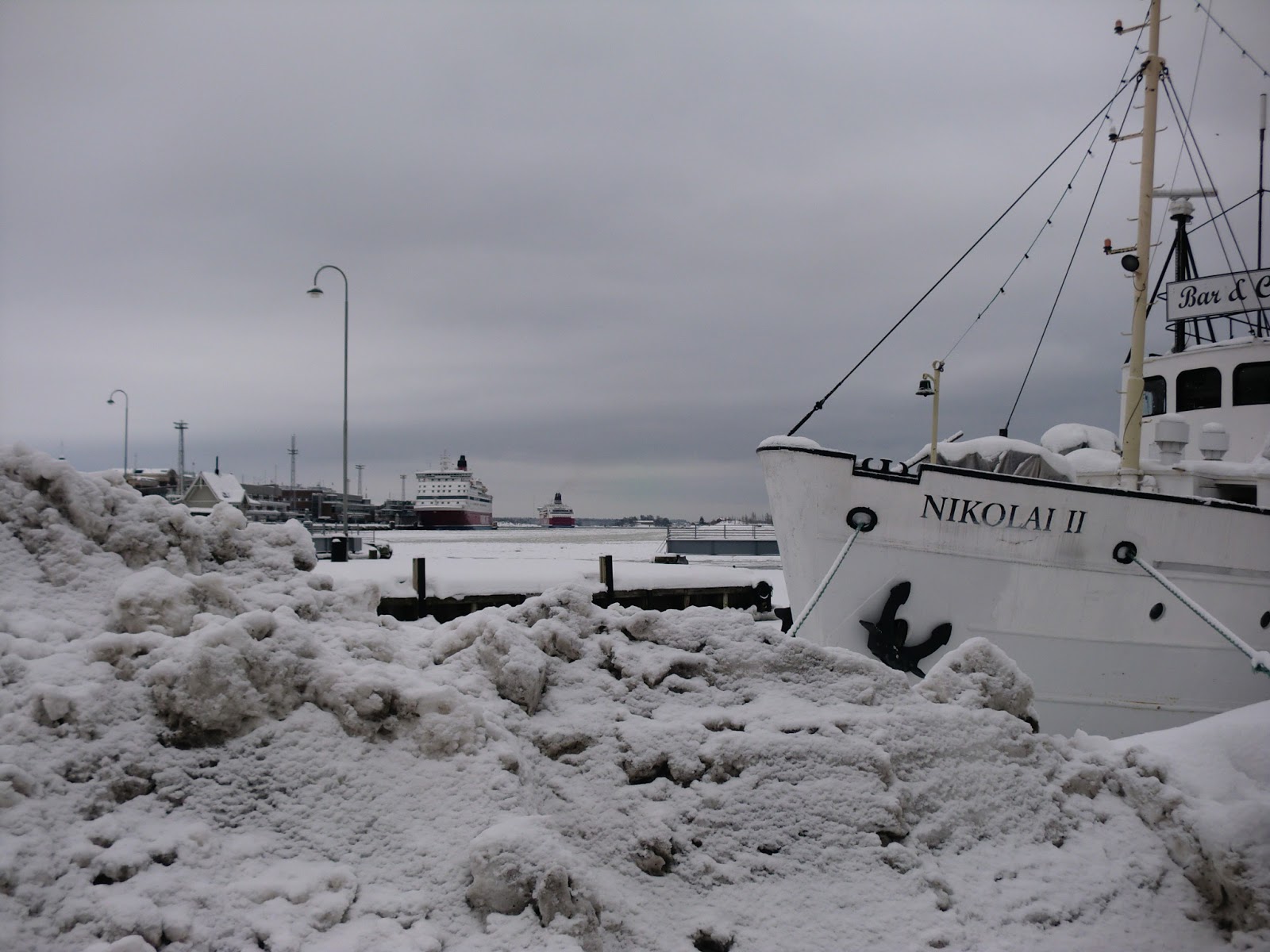
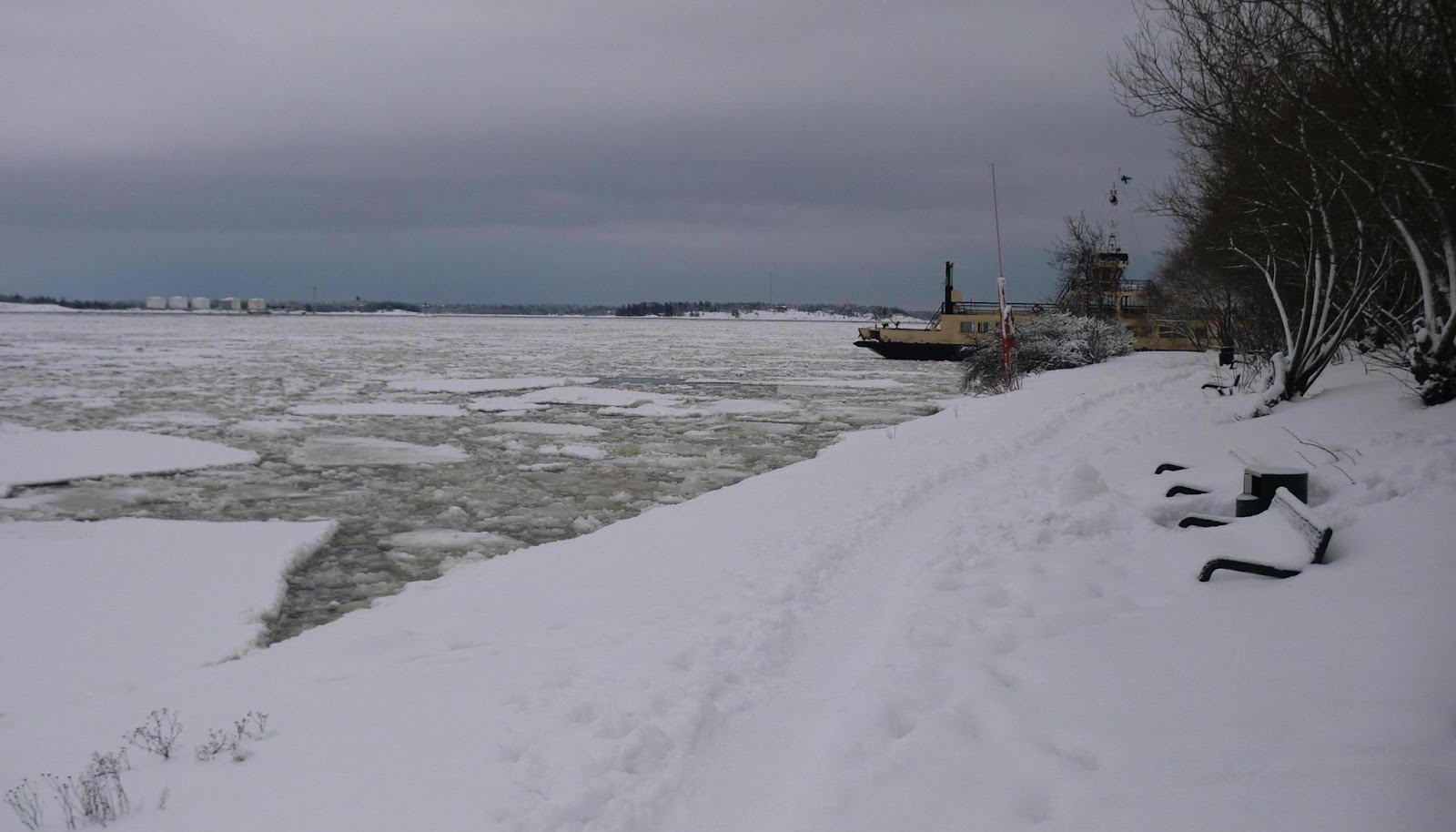
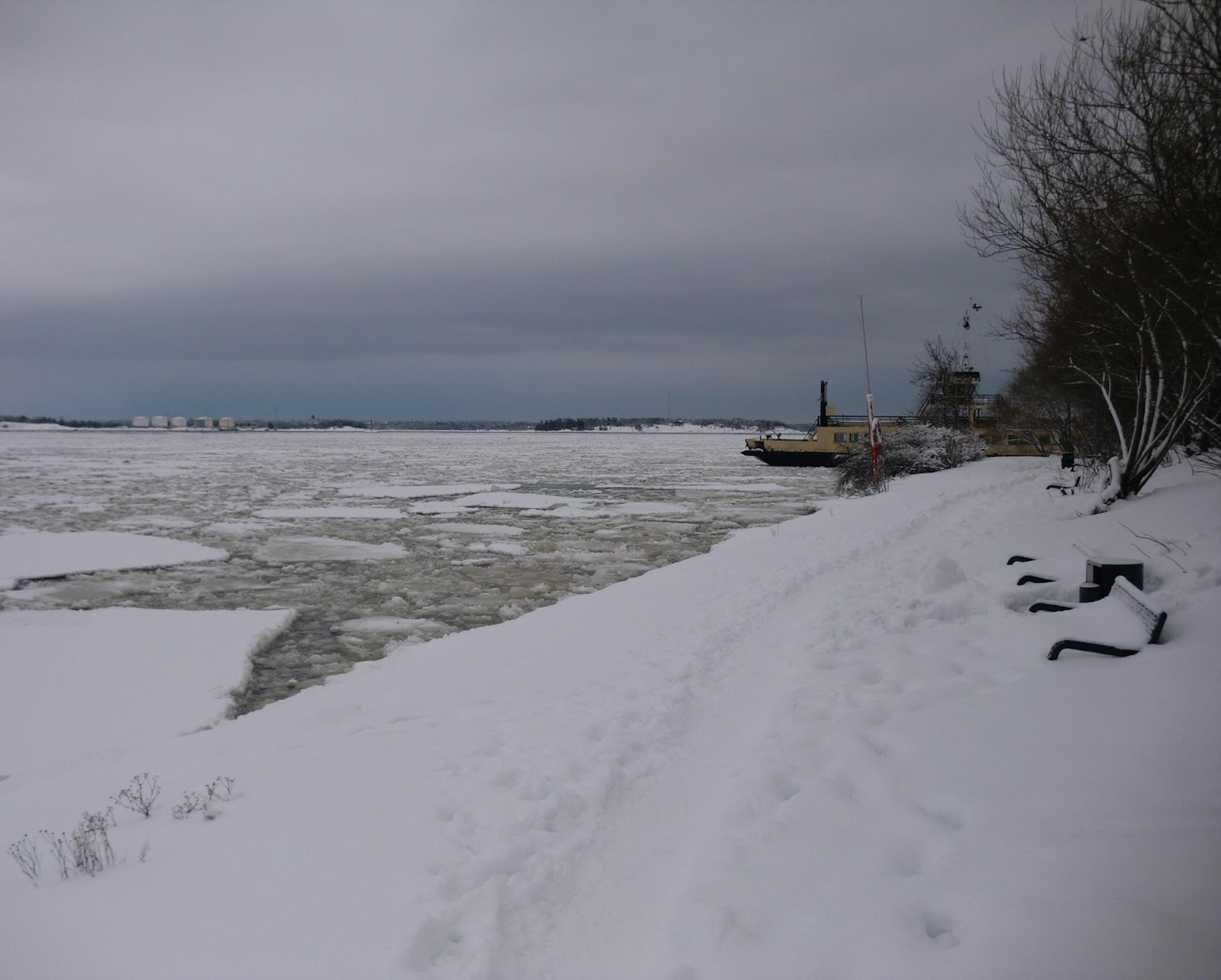
grey, winter Helsinki shore ...
I took today in Helsinki. There was calm, unhurried atmosphere
I like, and by atmosphere I mean the feeling, not the weather!:-)
Today there were only SISU and Nordica of the icebreakers in the northern shore of Katajanokka.
I guess the rest of them are on the icebreaking assignments.
| view to kruununhaka |
Thursday, February 7, 2013
The Imatrankoski Rapids, the dam of Imatra and Imatran Valtionhotelli in the winter
The Imatrankoski Rapids on the river Vuoksi in Imatra are the oldest Finnish tourist attraction. They have been popular place to see already in the 17th century. Empress of Russia - Catherine the Great came to admire them in 1772.
In 1920's on the rapids was built the dam as a part of the hydroelectric power plant. After opening the plant in 1928, the river does not flow freely. During summer there are daily shows accompanied by music, when the dam is opened letting the water flow for about 30 minutes.
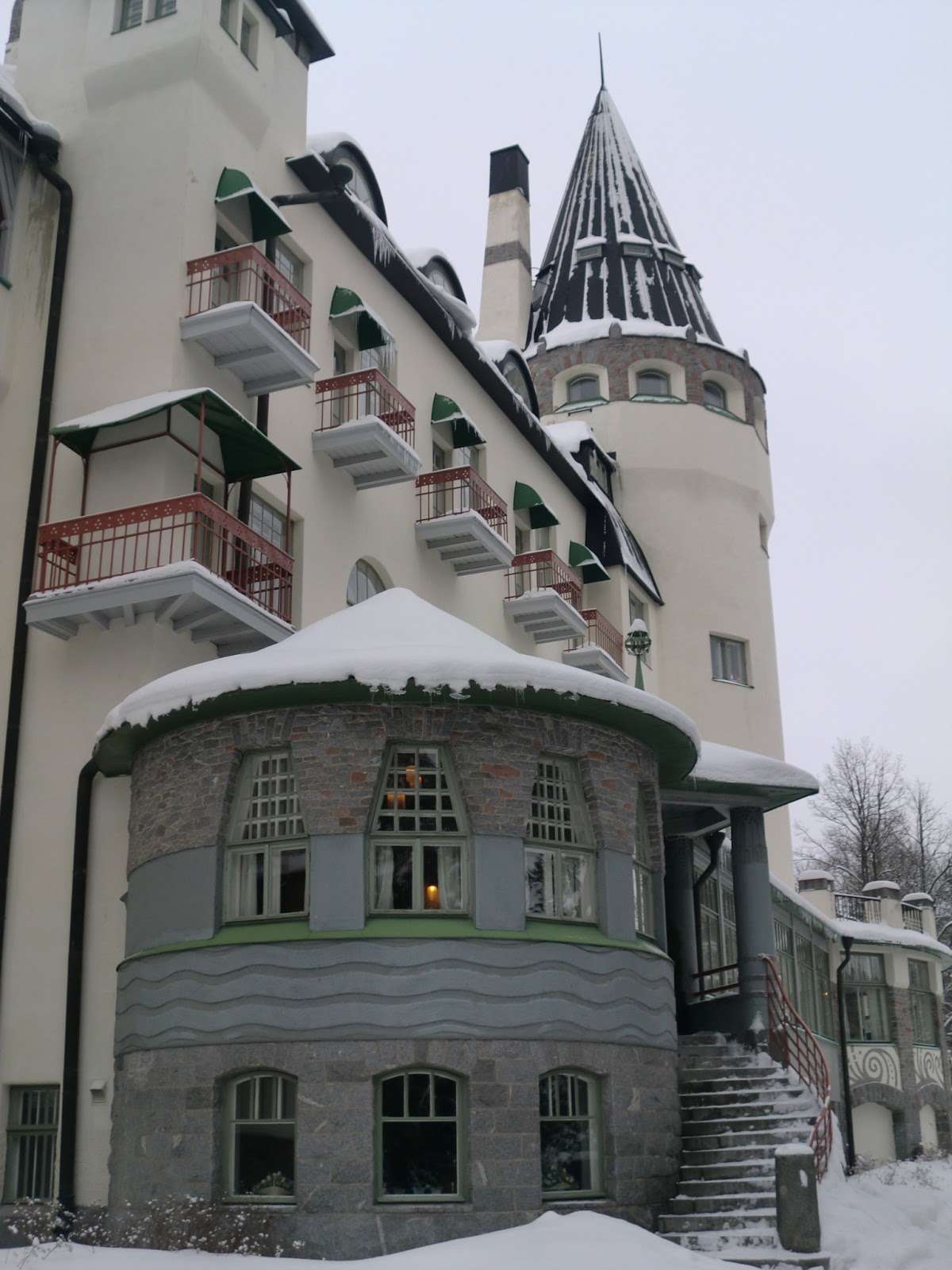
Imatran Valtionhotelli (the State Hotel) was built by the Finnish senate in 1903.
It is located very near to the dam and rapids. The hotel designed by Usko Nystroem is in an Art Nouveau (Jugend) style. It was built as a hotel for tourists from the Russian Imperial capital Saint Petersburg. As you can see it looks fabulous even in a grey winter day.
Tuesday, February 5, 2013
February 5th - the Runeberg's Day
is regarded as the national poet of Finland. Each year on the 5th of February Finnish cafés and groceries serve the Runeberg's Tarts (Runebergintortut) - round cakes flavored with almonds and rum or arrack, with raspberry jam and sugar ring icing on top.
The tarts are named aften his name and eaten in his honour.
Some facts about Runeberg:
- he was born in a Swedish-speaking family on 5th of February 1804,
- he wrote in Swedish as it was his mother tongue,
- his works were about the people and nature of Finland, Finnish peasants' life, persistency and determination (sisu). He also wrote patriotic poems on the Finnish War of 1808-09 with Russia,
- his poem "Vårt land" (Our Land, in Finnish "Maamme") became lyrics of the Finnish National Anthem,
- Jean Sibelius wrote music to number of his poems,
- Runeberg had also big influence on Swedish literature. He received Swedish Academy's highest award for poetry,
- in 1837 he became professor of Latin and Greek literature in the Borgå College (Gymnasium of Porvoo). In 1847 he was appointed rector of the college. Lived in Porvoo until death.
- in 1852 he moved with family to home, which is nowadays opened for public as the museum, (here's link in english),
- he was married to Fredrika Charlotta Runeberg, daughter of the archbishop of Finland,
- his wife was also a noted writer. She wrote historical novels and was the first Finnish newspaper-woman, - they had eight children,
- at age of 61 during a huntinting trip Runeberg suffered a stroke, after which he became severely incapacitated. His wife was taking imposing, everyday good care of him untill his death in 1877,
- the statue of Runeberg in Esplanadi Park in Helsinki was created by his son Walter Runeberg -
a great Finnish sculptor (his another famous work is the monument of Alexander II in Helsinki Senate Square),
- Runeberg's Day is a flag day in Finland
Runebergs Tarts, producers: Haagan leipä, Linkosuo, Rosten, Marian konditoria, Kakku & Leipä Keisari ja Fazer. Photo: http://ruoka.fi
Wednesday, January 30, 2013
different shades of the Finnish snow ...
There is popular belief that Eskimos have about hundred words for snow. I did small internet research on this subject and found out, that this number is vastly exaggerated.
The Eskimo languages are divided into two main groups (Yupik and Inuit) and numerous dialects.
They include many words of the same origin but in slightly modified versions within dialects, what gives impression of larger number of words than there really are.
According to Wikipedia Saami people (living in far northern parts of Finland, Norway, Sweden and Russia) use about 180 words for snow and ice. Ole Henrik Magga, Professor of Saami languistics from Saami University College in Guovdageaidnu, Norway, wrote interesting article: 'Diversity in Saami terminology for reindeer and snow' (here's link). He described there in English ca.90 Saami words for snow and ice. (and ca.140 relating to reindeers).
As to the Finnish words for snow and ice, someone has already done a big work to translate many of them into English what I have copied below to present complexity of this vocabulary. (here's the link to source I got it from):
'lumi: snow, pyry: snow shower, myräkkä: snowstorm, rae: hail, räntä: sleet, tuisku: snow shower with strong win, laviini: a small avalanche, hyhmä: snow floating atop water, loska: very wet snow; snow, water and mud mixed togethe, sohjo: slush, snow and water mixed together, ahto: pack-ica (broken & refrozen ice, ahtauma: a formation of pack-ice, jää: ice, kide: ice crystal, kohva: gray ice formed from wet snow, paanne: multi-layered ice (typically waves crash on top and freeze), railo: pressure ridge in ice, röpelö: uneven ice, tökkö: ice with frost on top, iljanne: a thin layer of snow atop ice, hanki: a even layer of snow on the ground, esp. if enough for skiin, huurre: rime; granular frost (the white stuff in your freezer), härmä: frost, kinos: snow drift; a loose pile of snow, esp. one formed by wind, kaljama: a thick layer of ice on the ground, lethal in the sprin, kuura: hoarfrost; frozen dew, nietos: a large, hard pile of snow (may be refrozen), nuoska: "snowballable" snow, usually formed when powdery snow melts a bit, polanne: a hard layer of compacted snow, tykky: large chunks of snow, esp. when frozen onto trees, viti: freshly fallen powdery snow, avanto: a hole in ice, jotos: reindeer tracks in snow, latu: a ski trail in snow, rannio: a reindeer path in deep snow.'
Additionally there are numerous words for snow and ice in Finnish dialects.
The most popular words relating to snow not listed above:
lumiukko - snowman
lumihiutale - snowflake
lumisade - snowfall
lumimyrsky - snowstorm, blizzard
Finnish military uniforms have always included the snow version (lumipuku), nowadays Finnish Defence Forces use snow trousers and jackets. There are also snow outfits for hunters.
Some of my snowy Finnish photos are here and here
Below photo taken from our window. I wonder what would be proper word for that ...
Tuesday, January 22, 2013
purple sunset
Exactly during midday I was riding bicycle. About 12 o'clock the sun reaches its highest point in the sky during the natural day, so I was surprised to see my shadow on the snowy road ca. 5m long!
Watching the dark sky at 8 am does not give much energy to start a new day. It is good to realize that anyhow every day becomes longer, so I appreciate this purple sunset and wait for more:-)
Wednesday, January 16, 2013
the road tunnels in Finland
I have been to Turku only once 10years ago, so I was surprised at the road tunnels we drived through on the Finnish national road 1 (Valtatie 1), (Motorway E18) from Helsinki. There are 7 double-bore road tunnels between Muurla and Lohja (Hepomäki, Lakiamäki, Tervakorpi, Pitkämäki, Orosmäki, Karnainen ja Lehmihaka).
Their combined lenght is 5,2km. The longest one - Karnainen Road Tunnel (Karnaisten tunneli) is 2,3km.
It's the longest road tunnel in Finland.
Tunnels' construction was completed in 2009.
Tunnels are equipped with the emergency exits and SOS-phones.
The road leading often between high rock walls
is nice and impressive.
The below picture comes from http://www.ykkostie.net/tunnelit.html
Here's LINK about other road tunnels in Finland, and below my photos of the tunnels:
It looks like Finns like the tunnels. Turun Sanomat newspaper from Turku published on 2.12.2012 project of Marco Casagrande (the picture below). The architect has vision of drilling tunnel under centre of Turku. He says "Lowering the road into a tunnel going under the Aura River would free the heart of Turku from cars for good. And Turku is worth it." (here's link to his blog, this post is in English). Reading comments on the internet I see that this project has many enthusiasts.
Times shows if this dream comes true ...
Thursday, January 10, 2013
Short winter trip to Naantali and Turku
After spending Christmas at home we left to Naantali and Turku for few
days for a change.
The weather seems to stay gloomy forever. The amount of coffee I drink increases every day
and the winter will last here at least until April.
I find small consolation in fact, that days are becoming longer since Christmas.
Naantali is under 20000 of population city 15km from Turku. Small beautiful city most known for the Moomin World and Naantali Spa Hotel. The Moomin World is closed during winter.
We visited Turku Cathedral, Finland's national shrine. It was built already in the late XIII century, initially as a wooden church, 100years later rebuilt with stone. The cathedral is tremendous and really impressive.
Tuesday, January 1, 2013
Have a very Happy New Year 2013! Onnellista Uutta Vuotta! Szczęśliwego Nowego Roku!
Wednesday, December 26, 2012
Christmas cards overview
It came to my mind to make a short overview of the Christmas cards I got this year.
Looking at the cards sent from Finland and from Poland I can see a clear difference.
Some of the Polish cards present Santa Claus or the Christmas tree, some are amusing but most of them refer to the birth of Christ, present Nativity scenes or the Three Wise Men.
The Finnish cards in general present a different approach. I have seen mostly cheerful elfs, Santa Claus, reindeers, the forest animals and snowmen.
I see every year cards with photos of the animals with the christmas hats on (tonttulakki).
I must admit that I have mixed feelings about them, maybe because I got used to the religious Polish cards. Anyhow my son asked me to buy the cat and the dog card to 'decorate' our kitchen, so we have these ones home also:-).
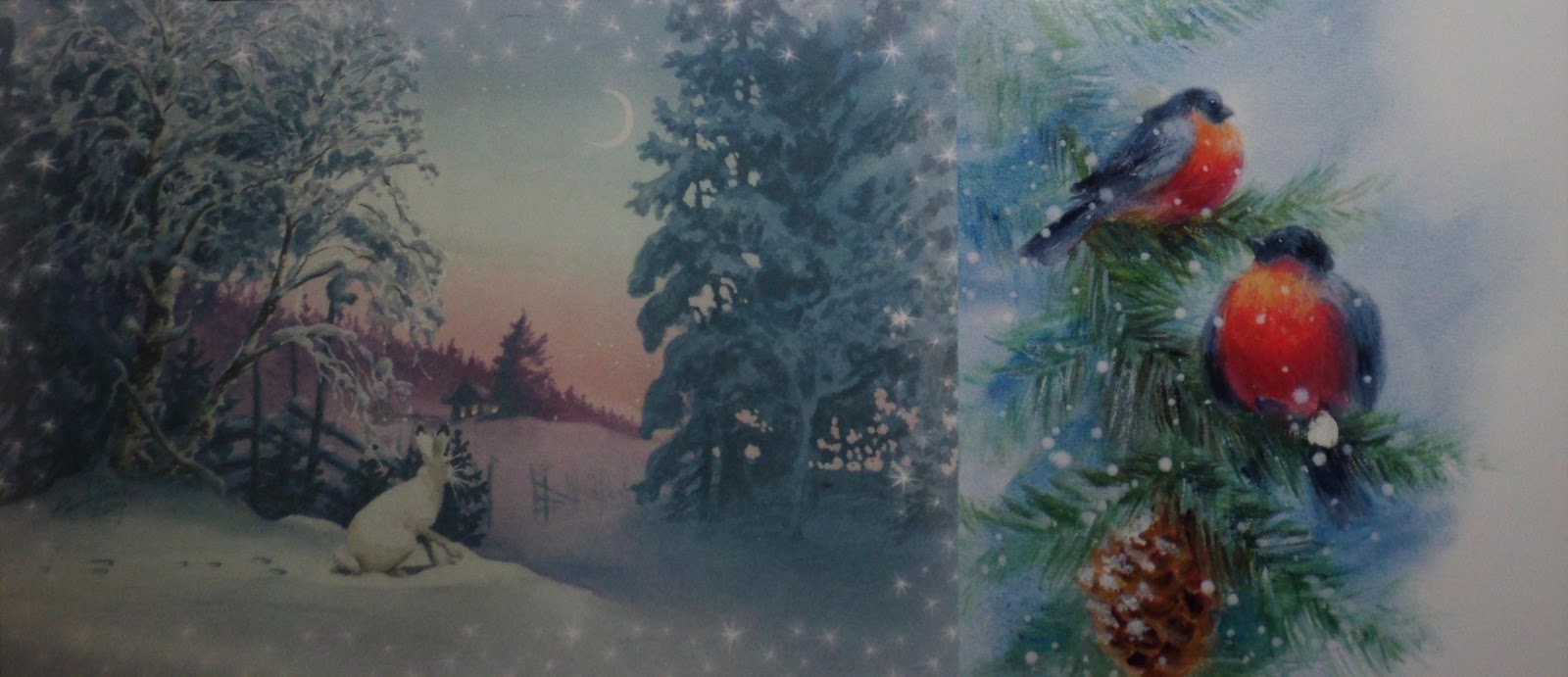
There are of course also Finnish earnest cards wishing the Peaceful or the Blessed Christmas (including picture of church, Jesus, angels or candle), and the winter nature scenes cards, often with photos or ilustrations of the bullfinches (punatulkku) or forest.
I would like to present also a very original Christmas card I got this year, reproduction of work of the Finnish artist Reetta Isotupa-Siltanen:-)
Ach! and of course the handmade ones which my sons created this year:
Looking at the cards sent from Finland and from Poland I can see a clear difference.
Some of the Polish cards present Santa Claus or the Christmas tree, some are amusing but most of them refer to the birth of Christ, present Nativity scenes or the Three Wise Men.
The Finnish cards in general present a different approach. I have seen mostly cheerful elfs, Santa Claus, reindeers, the forest animals and snowmen.
I see every year cards with photos of the animals with the christmas hats on (tonttulakki).
I must admit that I have mixed feelings about them, maybe because I got used to the religious Polish cards. Anyhow my son asked me to buy the cat and the dog card to 'decorate' our kitchen, so we have these ones home also:-).
There are of course also Finnish earnest cards wishing the Peaceful or the Blessed Christmas (including picture of church, Jesus, angels or candle), and the winter nature scenes cards, often with photos or ilustrations of the bullfinches (punatulkku) or forest.
Tuesday, December 25, 2012
Merry Christmas Everyone!
"Christmas is a time when you get homesick - even when you're home". Carol Nelson
I find this quote adequate to this blog but not because I am Pole spending Christmas in Finland.
I noticed, that Christmas brings to my mind thoughts about Christmas of my childhood, so no mater where I spend Christmas nowadays I would miss Christmases from the old times.
It was a magical time and the whole world seemed to be envolved into a celebration.
On the Polish Christmas Eve supper all the family members gather togehter to fulfill tradition of breaking off and exchanging parts of the opłatek (wafer baked from pure wheat flour and water).
It is symbol of exchanging blessings and good wishes.
Christmas Eve in Poland is a day of fasting. At the appearance of the first star starts the Christmas Eve supper but there is any meat on the table. The main dish is fried carp and beetroot soup - while in Finland a main dish on a Christmas Eve supper is joulukinkku (Christmas ham:-)
There is also Midnight Mass celebrating the birth of Jesus Christ.
My father used to buy a real Christmas tree to our home, and I remember each of over hundred of baubles and other decorations.
We used to visit different churches to admire the Nativity scenes and the Christmas trees and lights. The Christmas carols in Poland are numerous, beautiful and very popular not only in churches.
Im sure that every Pole of my age remembers 'Christmas oranges', cause during communist time oranges and lemons were available in Poland only around Christmas time.
Santa Claus used to visit Polish children on 6th of December. (Finland's Independence Day:-)
Tradition of exchanging gifts during Christmas came later from abroad. It appeared in our family when I was already teenager.
I will finish with another quote: "There's nothing sadder in this world than to awake Christmas morning and not be a child". Erma Bombeck
Merry Christmas!
Hyvää Joulua!
Radosnych Świąt Bożego Narodzenia!
Wednesday, December 19, 2012
pre-Christmas hurry in Finland
There is a tradition of pikkujoulu in Finland. Literally it means "small Christmas".
Pikkujoulu is a pre-Christmas party organized by seems like every workplace, company, office, school, kindergarten or club. The character of the party can differ, but you can always expect to taste there some glögi (mulled wine) and piparkakut (ginger biscuits). Commonly pre-Christmas parties include traditional Finnish Christmas food like Christmas ham, rosolli (salad with boiled beetroots, potatoes, carrots, apples and pickled cucumber) and the potato, carrot, rutabaga and liver casseroles. The pikkujoulu season starts already in November.
My 3 years old son attended pikkujoulu in the kindergarten, where kids were i.a. singing, making Christmas decorations and baking ginger biscuits. My 7 years old son had pikkujoulu at school, another one arranged by the Polish school and the 3rd one with his colleagues from the wrestling trainings.
There was also pikkujoulu arranged by our neighbours, financed by the housing company.
You do not need to be very social to be invited to some pikkujoulu. It is enough to be a part of some society or group of people, and actually everyone belongs to some group for which pikkujoulu is arranged. There are also open pre-Christmas parties for everyone.
Another pre-Christmas event is "Kauneimmat Joululaulut" - traditional Finnish carol service held at the Lutheran churches. There is also tradition of the Christmas markets, where you can buy Christmas decorations, handcraft, food, sweets etc.
Subscribe to:
Posts (Atom)